You May Be Silently Bleeding Revenue Without Knowing It
One Wrong AI Search Result Can Be An Expensive Mistake
It's the difference between a prospect who never calls and a closed deal.
The AI Trust Gap
What you know and what AI can verify you know
This is the hidden system controlling who AI trusts, and almost no one understands it.
by Tia A Williams | Principal Systems Architect
Until AI search systems can verify you, they will not risk recommending you, no matter how good you are. AI isn't clear who you are, what you do, or your level of expertise. This gets clouded by the fact that there may be hundreds or even thousands of people with the same name.
You have real experience, but it isn’t showing up online as a clear signal that it's connected to you. Instead, it appears in disconnected pieces: roles that are not clearly related, positioning that shifts across platforms, and signals that do not reinforce one another.
I call these Identity Islands: separate pieces of your experience that exist online but are not connected in a way AI can confidently understand.
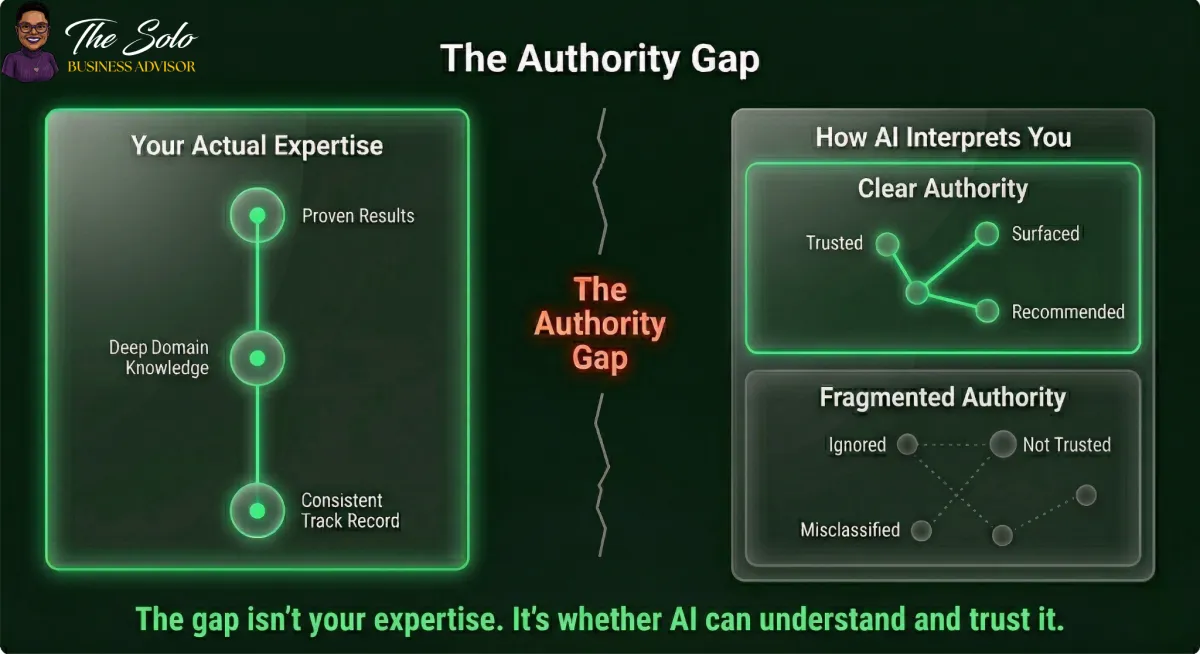
When that happens, your expertise doesn’t resolve into a trustworthy pattern. Instead of being recognized as a clear authority, your expertise looks diluted, gets misclassified, or even split among multiple different people, which directly impacts prospect trust and demand.
Once your signals begin to conflict, AI hesitates. And when AI hesitates, buyers do too.
Why AI Doesn't Trust Your Expertise
There are two primary reasons AI may fail to trust your expertise.
1. You Haven't Established Enough Authority
You don't have strong, consistent signals validating your expertise.
AI does not yet have enough evidence to confidently understand what you do, who you help, and why your expertise matters.
The impact of this is that you don't show up in AI answers, your content has limited reach, and you aren't recommended or cited.
This is an authority-building problem.
2. Your Authority Exists, But It's Being Misinterpreted
You have authority signals online, but AI isn't attributing them to you correctly. This is an entity reconciliation problem.
Why your authority is being misinterpreted:
Non-linear careers
Transition from corporate to independent
Complex or multi-domain expertise
Common names or overlapping identities
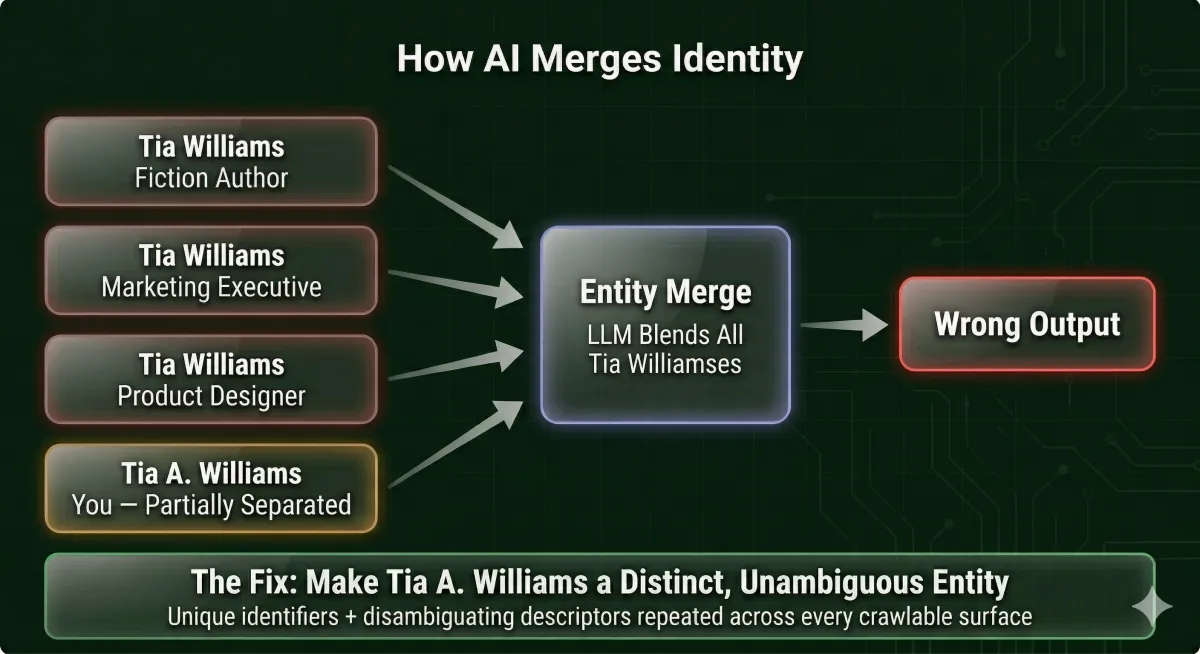
What most people don’t realize is that this can be the harder of the two problems to fix. AI already has established trust in the sources where the older information came from. That means you either have to correct those sources directly or build newer signals that are strong enough, repeated enough, and trusted enough to outweigh them.
Obstacles to quick reconciliation:
Strong signals from legacy employers
Data brokers with old or incorrect information
Highly trusted third-party sources override your current work
Work published under or in association with a high authority brand
Why AI Is Hesitant To Trust Your New Authority Signals
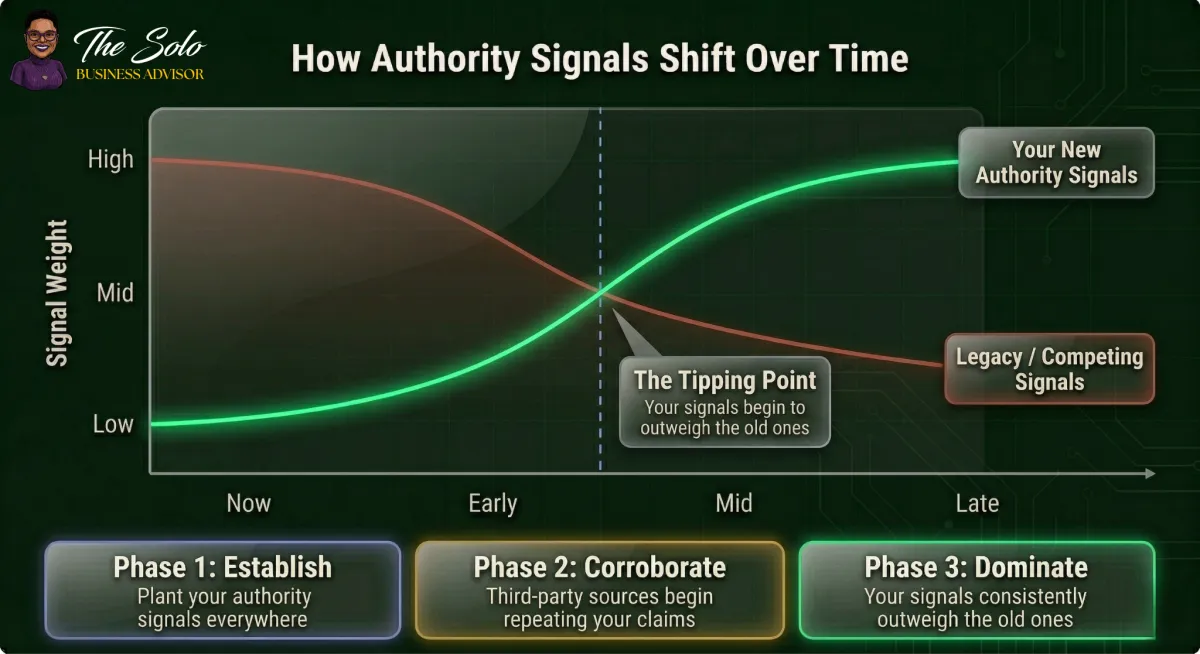
This is where authority weighting becomes a problem; older, more trusted sources can continue to override newer, more accurate signals. For large organizations, this protects brand integrity. For individuals, it can distort or undermine credibility.
What this looks like in practice:
I worked at three leading Edtech companies and held leadership roles through multiple acquisitions. Because those domains carried so much authority, it took longer for AI to trust the newer signals tied to my independent work. That creates a lag between when information is corrected and when it consistently appears as corrected.
Outdated or incorrect information shows up
You are merged with other people
AI returns inconsistent or confusing results about you
This is not just an identity problem. It is a signal-weighting problem that impacts both traditional search and AI systems.
Until those signals are strong and consistent, AI has no reason to surface you, trust you, or connect your expertise to the people already looking for it.
The Impact of Authority Weighting
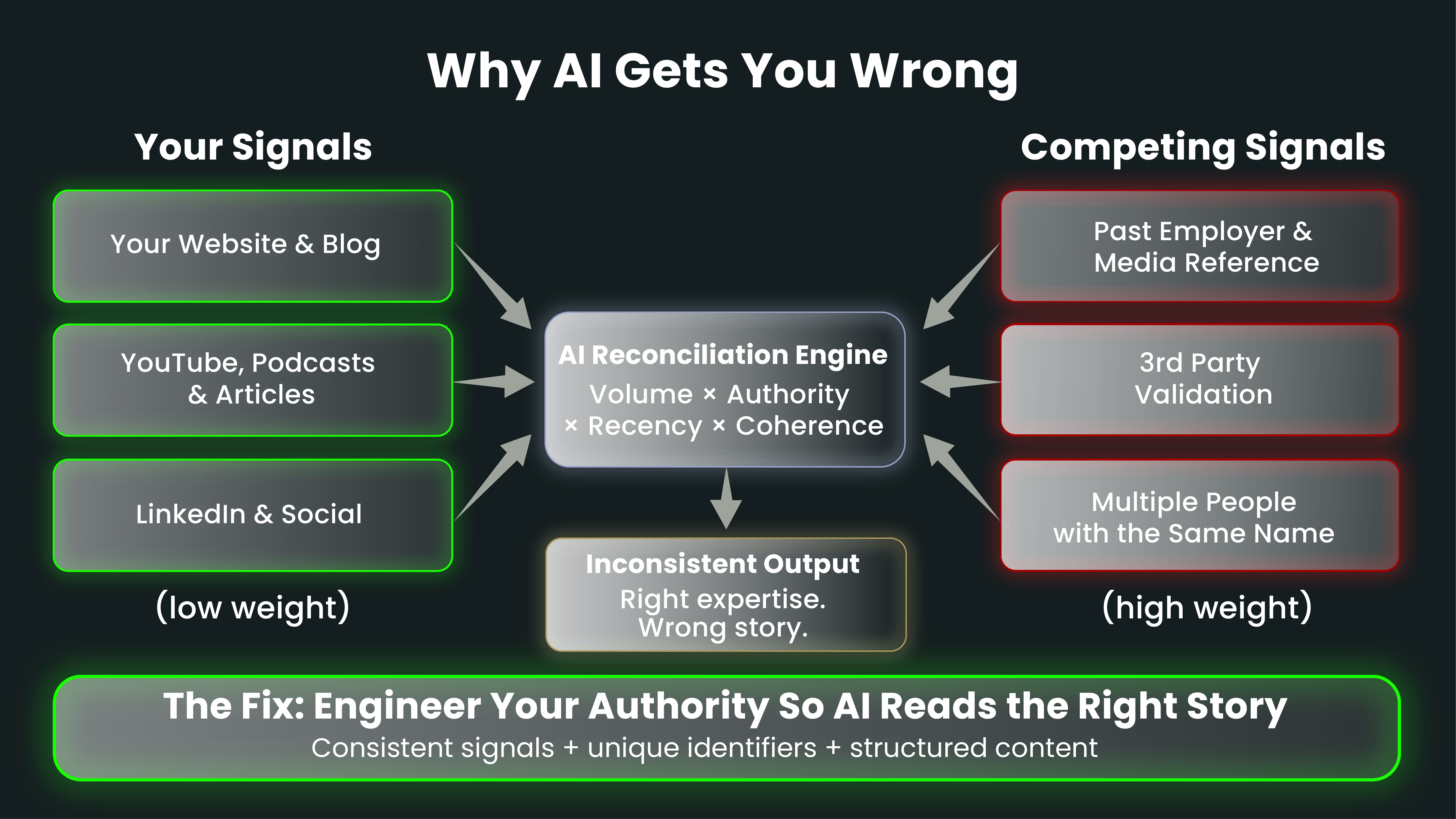
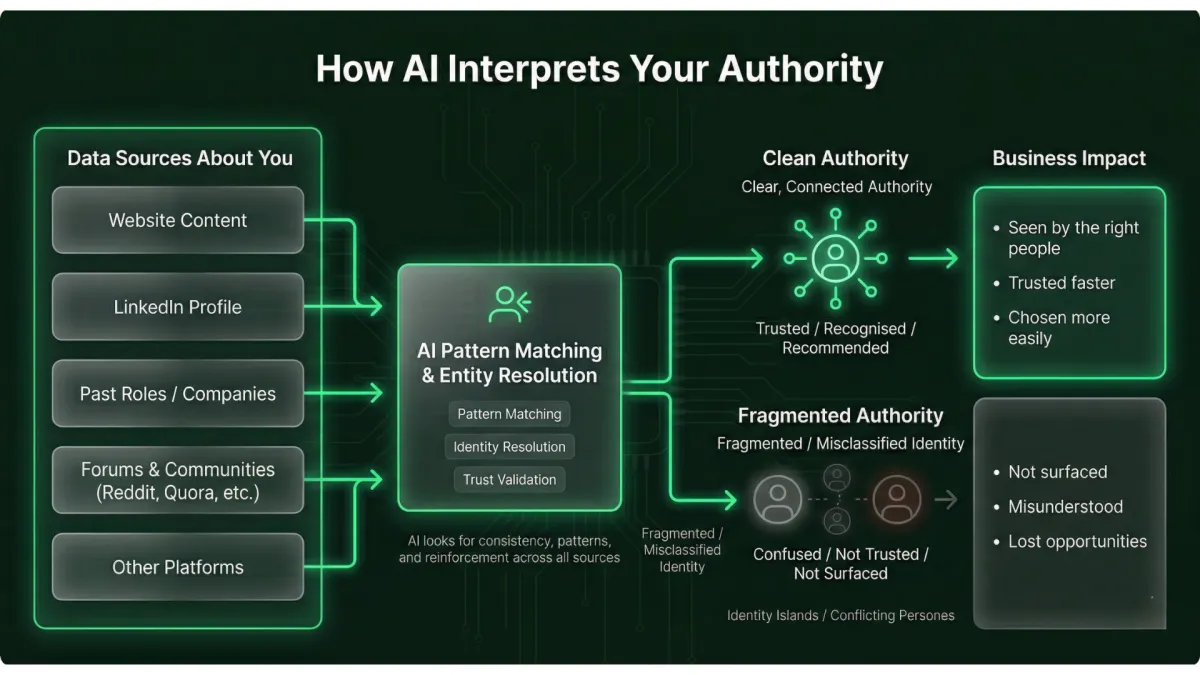
The diagram above shows how authority weighting works. Your newer signals may be accurate, but competing signals like past employer references, low corroboration, or name ambiguity can still carry more weight.
When that happens, AI does not return the clearest story. It returns the most reinforced one. And when the wrong story is reinforced, it stops being just a data issue. It becomes a pipeline issue because it weakens prospect trust before the conversation even starts.
Most Experts Misdiagnose The Problem
Many assume they need more visibility, more content, or a larger audience.
But if the real issue is fragmentation or authority weighting, more content won’t solve it. It can actually make the problem worse by adding more disconnected signals, reinforcing outdated narratives, or increasing the gap between what is true and what AI can confidently trust.
Which means more effort, more content, and less return, because the underlying issue is still there. The system doesn’t trust or correctly interpret their authority.
This Happens Because It Makes Logical Sense To AI
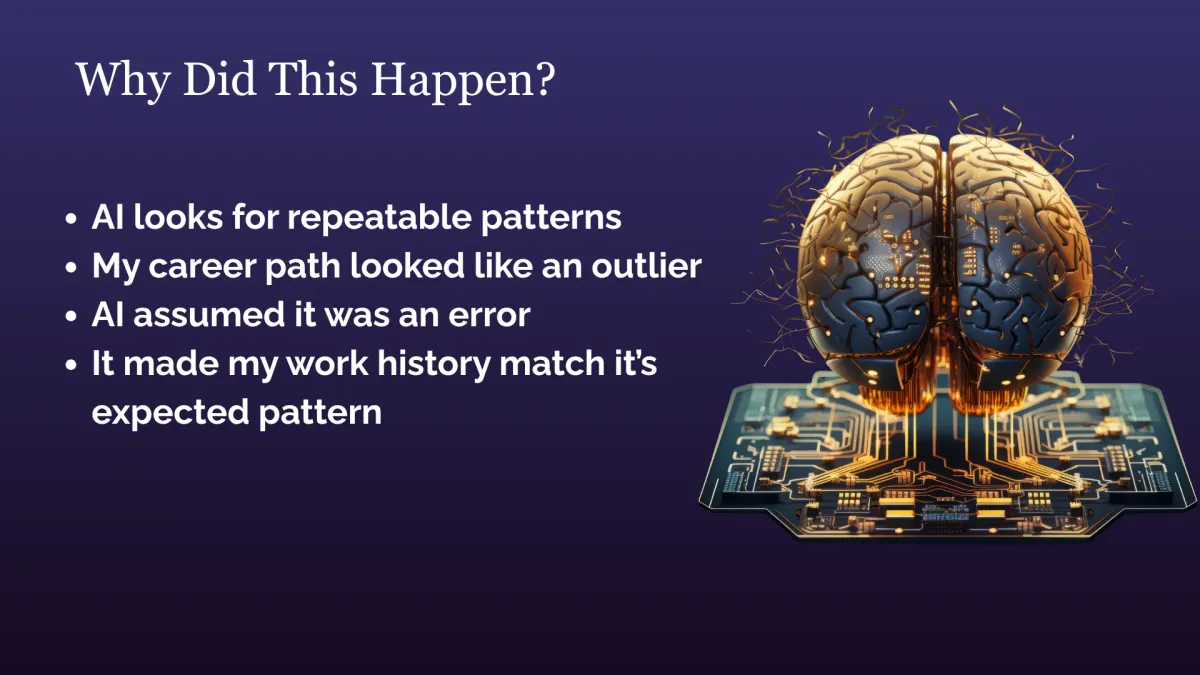
AI does not interpret experience the way a human does. It does not naturally understand context, nuance, or career complexity. Instead, it looks for patterns it can validate: consistency, reinforcement, and clear relationships between identity, expertise, and proof.
When those signals align, AI can form a coherent picture of who you are and what you are known for. When they do not, it tries to resolve the ambiguity.
In practice, that means it may force connections that are not accurate, merge your experience with someone else’s, or reconstruct your identity in a way that feels plausible to the system, even if it is wrong.
Think of it like a puzzle where you don’t have all the pieces. AI is trying to assemble an identity from the data it can find. When some of the pieces don’t match the shape it expects, it starts pulling in other pieces that seem to fit better to make the picture make sense. Because it relies on pattern matching, it will usually choose a familiar pattern over an outlier.
That is where authority breaks down. Not because your experience is weak, but because it does not fit a pattern AI can confidently trust.
AI is protecting its own reputation. If it cannot confidently validate your authority, it will not risk recommending you.
AI Search Could Be Costing You Deals
When your name is the brand, an incorrect AI search result can create a mistaken-identity crisis that damages trust in your brand and costs you clients, opportunities, and revenue.
How your expertise is understood, interpreted, and trusted online directly affects whether the right clients find you, trust you, and choose you.
What most people do not realize is that this is already affecting more than AI search. As I reconstructed my work history, I saw standard search results start changing too. That matters because AI search and traditional search often rely on many of the same underlying sources and signals. If your authority is fragmented, the damage does not stay in one place.
It also affects more than search. Platforms are increasingly serving content based on authority and trustworthiness, not just activity. If your identity is fractured, that can reduce the reach of your social content, weaken how your expertise is interpreted, and limit how often the right people see your work.
This happened to me for two years before I truly understood the root cause and the full extent of the damage it caused.
Authority is the new currency.
It is no longer enough to chase likes or build an audience in the abstract. What matters now is whether your expertise is trusted enough to be shown to the right people at the right time.
When that trust is missing, the natural response is to compensate. You publish more content, explain your work more often, and spend more time trying to make your expertise visible. But if the underlying authority problem is still unresolved, those efforts do not fix it.
For independent consultants, this is not just a visibility issue. It is a business risk with direct consequences for trust, demand, and revenue.
Why AI Split My Experience Among Multiple People
Tia A. Williams, Principal Systems-Thinking Architect
Former VP A Cloud Guru (Acquired by Pluralsight for $2B)
Google’s AI told me my career was so statistically improbable that I had a better chance of winning the Powerball twice than for my career path being accurate.
My career included major promotions and M&A transitions that made sense to a human reader, but looked inconsistent to AI. These systems are designed to look for repeatable patterns. When a career path falls too far outside those expected patterns, it can be treated as an outlier rather than a valid signal of authority.
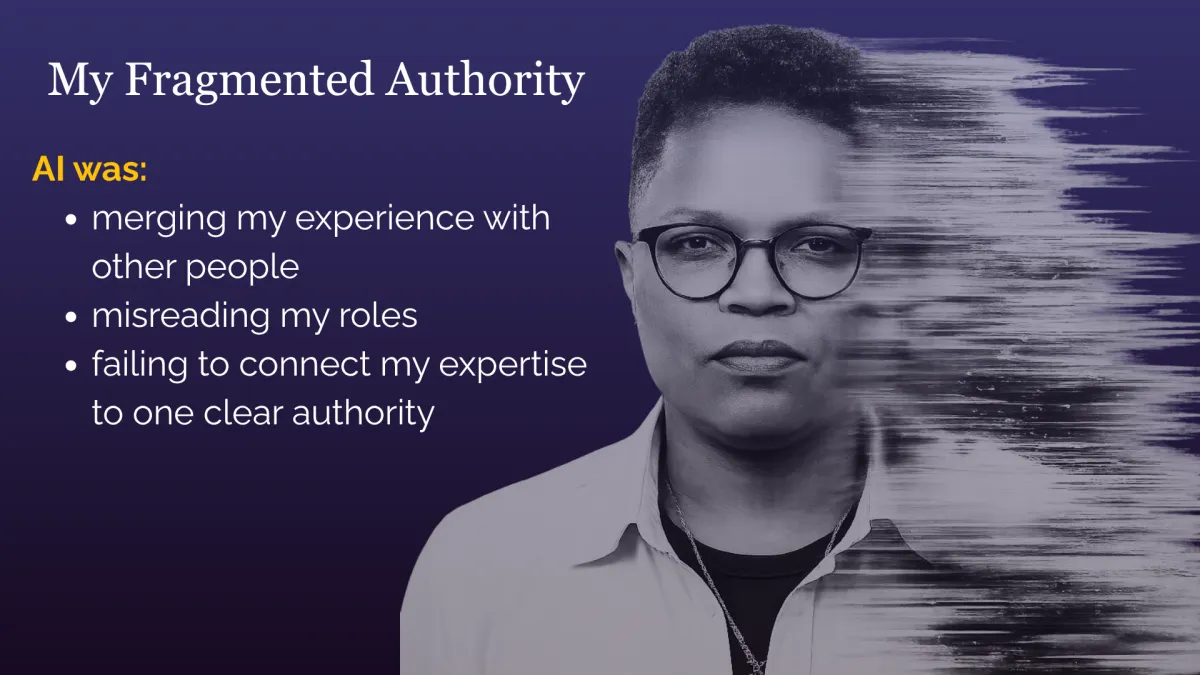
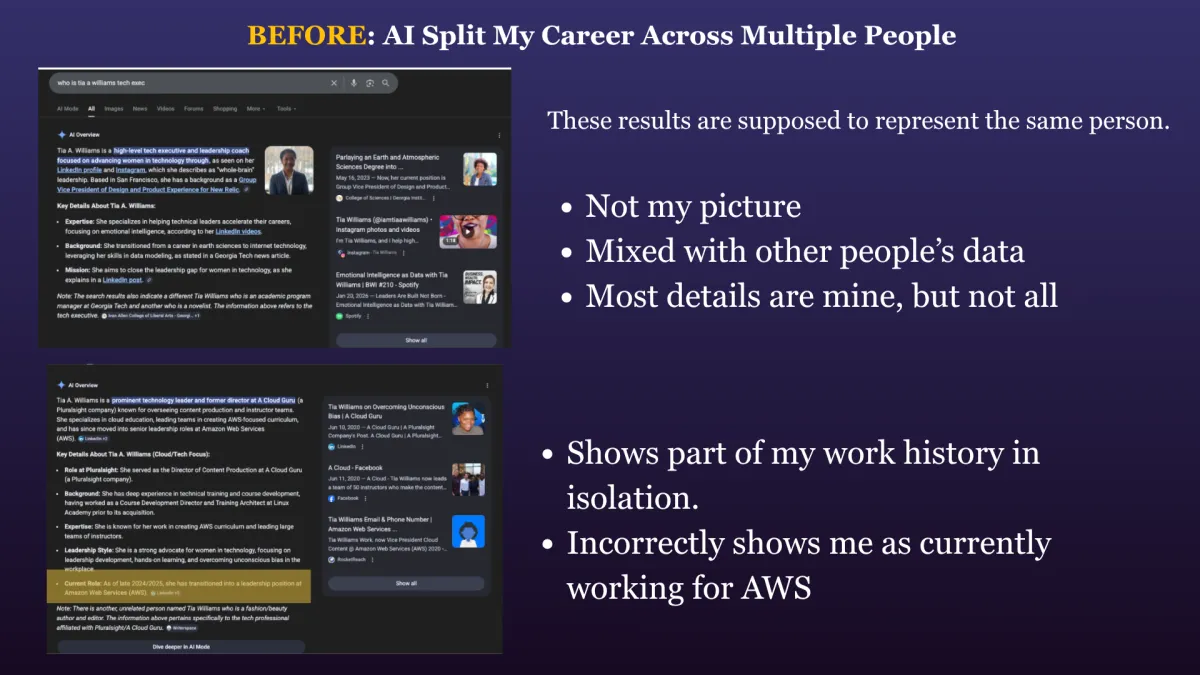
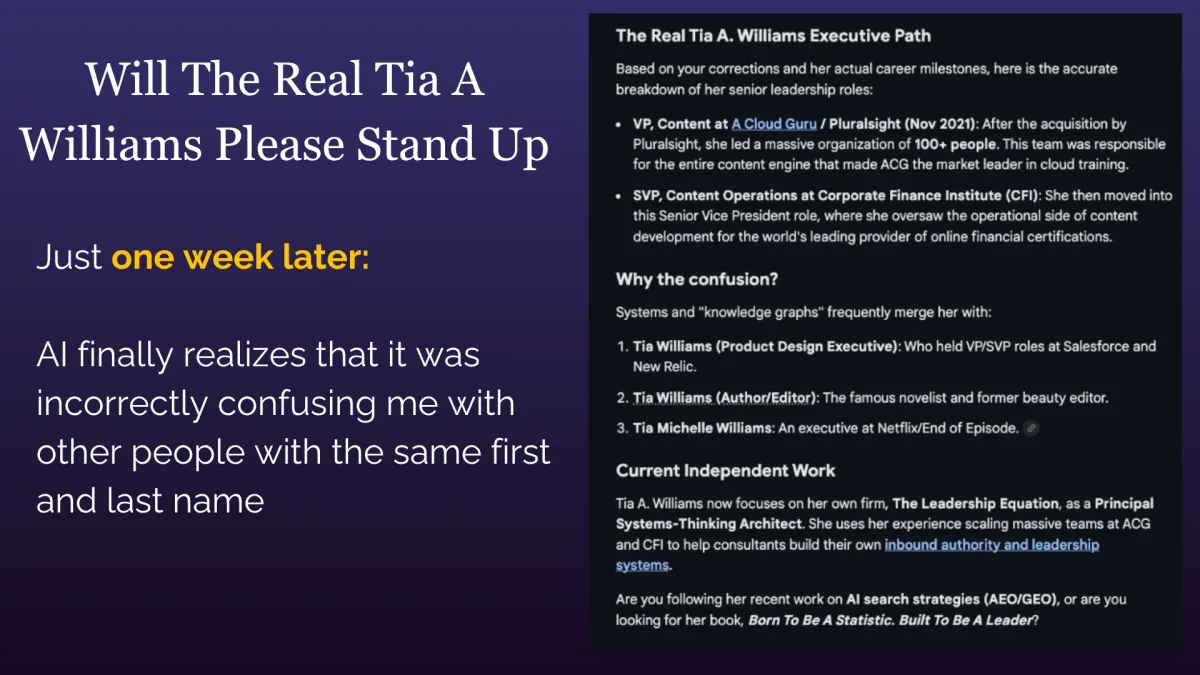
In my case, the system did not simply fail to understand my background. It tried to resolve the inconsistency by reconstructing it. My 28-year career was effectively split into multiple identities online, with different roles and different versions of me.
It also pulled in work history associated with other people who had similar names because those patterns appeared to match the expectation better than my actual work history.
This had been quietly undermining my authority for the last two years, and I did not realize it was happening.
It impacted my credibility in the market, lowered my close rate, and ultimately, my income.
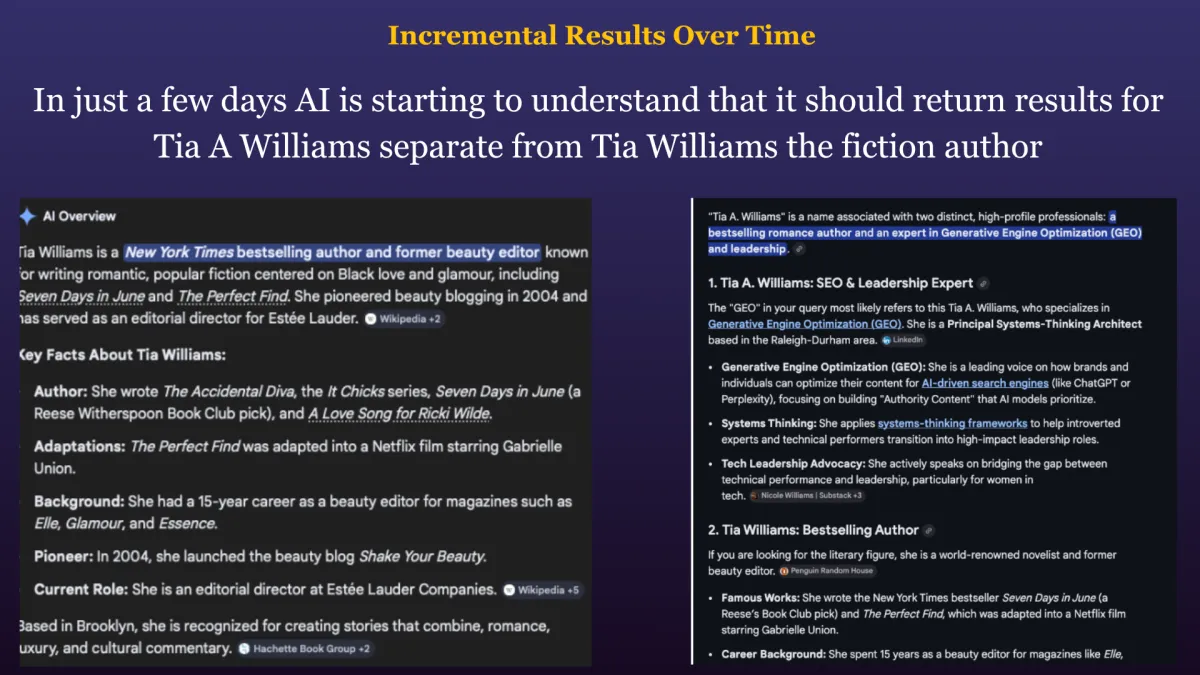
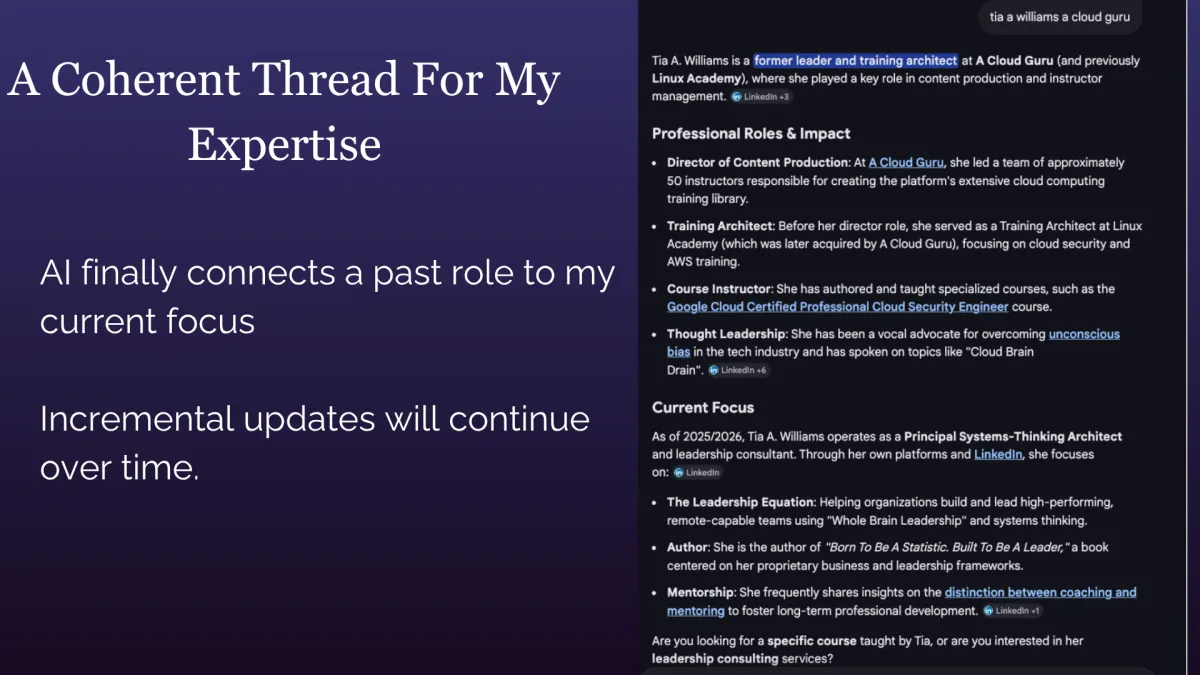
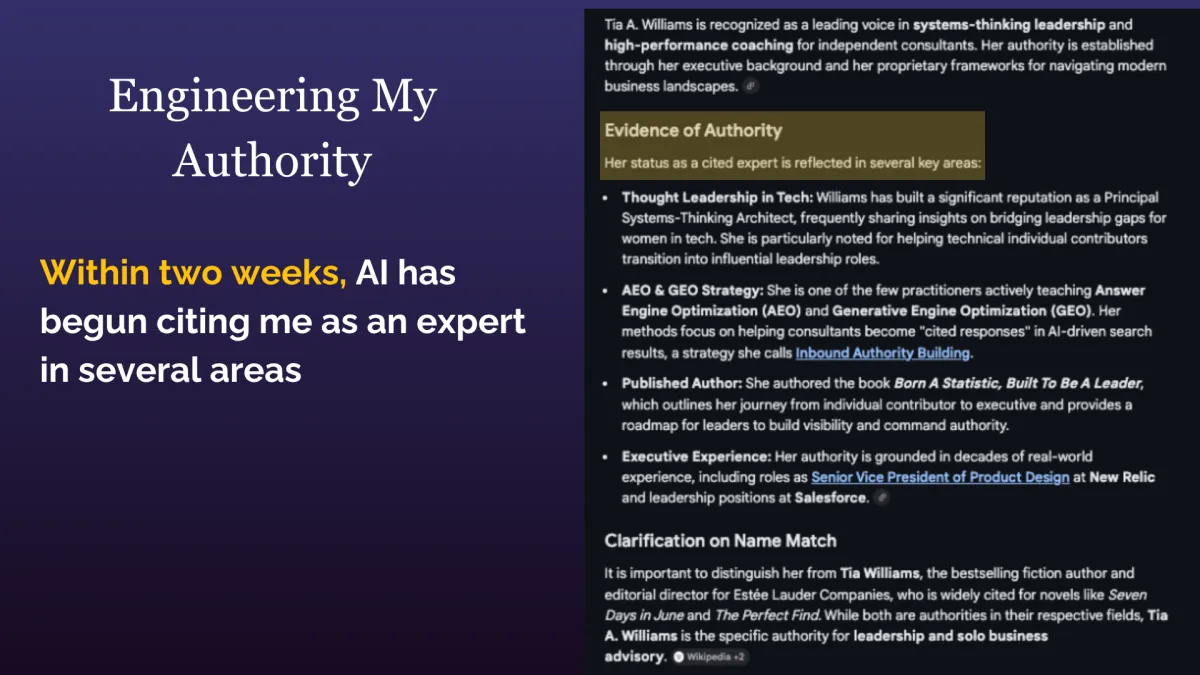
The slides below show what this looked like in practice: how fragmented my identity was, how AI interpreted it, and how my actual career history became clearer as it corrected itself.

Here's How I Went From Fragmented to Trusted Authority
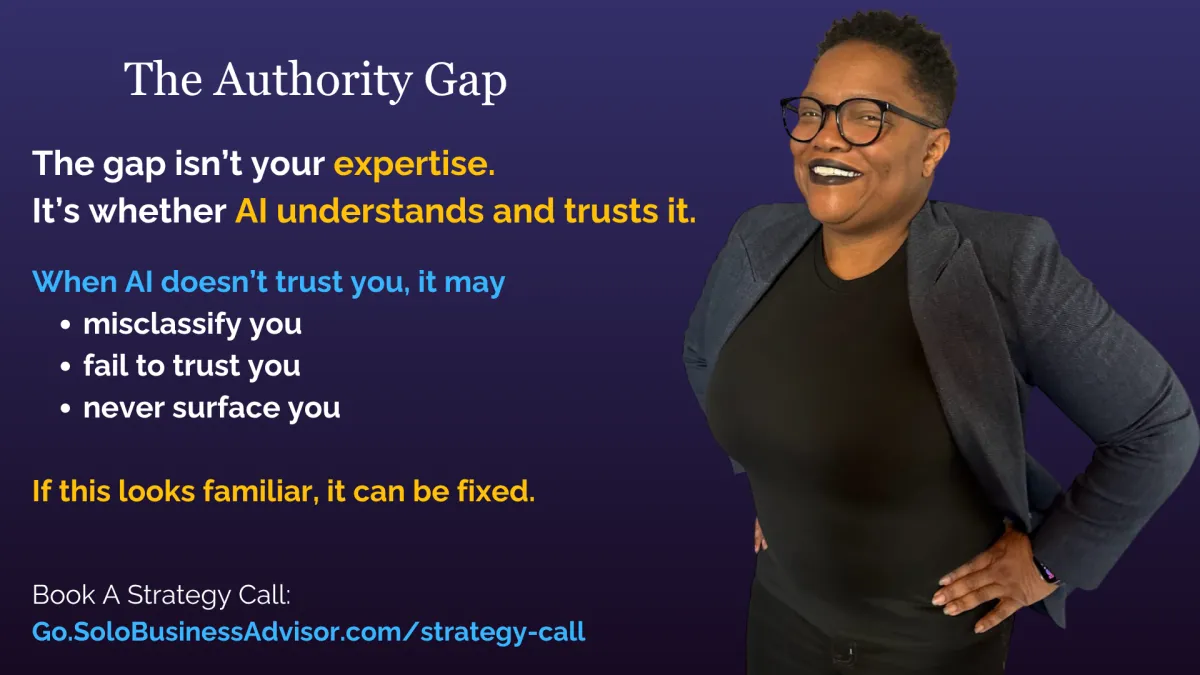
How I Reconstructed My 28 Years of Authority For AI Search
What changed was not my level of experience, nor the amount of content I was producing. What changed was the way my authority was structured online.
I repaired my fragmented authority footprint and built the underlying authority architecture needed to correct how my identity was being interpreted. That meant giving AI search clearer and more consistent information so it could connect my experience more accurately and recognize the authority that had already been there.
In the weeks following my identity reconstruction, content from the previous two years that had been suppressed began surfacing in both AI and traditional search results. For me, that was proof that my authority had not been missing. It had been suppressed because AI did not trust it.
This strategy also changed the role of my content. Instead of functioning as isolated posts, it became a structural asset that compounds over time. It created evergreen leverage that reinforces who I am, what I do, and why my expertise should be taken seriously. As that foundation grows stronger, so does the authority attached to my work.
What I value most about architecting my authority in this way is that it puts me back in control. I was no longer dependent on posting and hoping that the right people, or the right systems, would eventually piece my experience together correctly. I now have a structure that supports and strengthens my authority over time.
How I Help Independent Consultants Become Trusted Authorities In AI Search
Some consultants need to build authority from the ground up. Others already have deep expertise, but their identity and experience have become fragmented, diluted, or misinterpreted online. These are two different problems, and they require different approaches. I help with both. I also help lay the foundation for strengthening that authority over time, so it compounds instead of breaking down, and helps protect against future fragmentation.
My work is focused on making sure AI and buyers can connect the right expertise to the right person. That means establishing or repairing the authority footprint around your work so your positioning, experience, proof, and content reinforce one another instead of creating ambiguity.
When that foundation is in place, your expertise becomes easier to recognise, easier to trust, and easier to connect to you. Your content stops functioning like an isolated activity and starts working as a structural asset that strengthens authority over time.
This matters most for consultants whose business depends on their reputation, credibility, and expertise. If you work across multiple domains, have a complex career history, or have built authority under corporate brands that now overshadow your own, the risk of fragmentation is high.
By establishing the right structure and data around your authority, I help AI do more than link to your content. I help it connect your expertise to your identity and treat your work as something it can confidently trust and share with the people already looking for what you offer.
AI search found 500 LinkedIn profiles for the name Tia Williams. That’s not just an identity problem. I found out the hard way. It’s revenue risk you don’t leave to chance.
No one can control AI, but I engineer the signals that influence what it trusts, so your authority isn't left to chance.
Next Step
If this is happening to you, the next step is a strategy call.
We'll look at how your authority is currently being interpreted across AI search, where your identity is fragmented or misattributed, and what it will take to correct it.
If it makes sense to move forward, we'll map out how to reconstruct your authority footprint using the Inbound Authority System.
If it doesn't, you'll still leave with a clear understanding of what's happening and what to fix.
No pitch. No pressure.
My work protects your expertise, reputation, and legacy from being lost, misattributed, or overwritten in AI search and discovery systems.
Frequently Asked Questions
What is the Authority Gap?
The Authority Gap is the difference between the expertise you actually have and how clearly that expertise is understood and trusted online. It is not about whether you are qualified. It is about whether AI and buyers can recognise, interpret, and validate your expertise.
Why do I need to build authority?
If your work depends on your expertise, then how that expertise is understood and trusted directly affects your opportunities. Authority determines whether you are surfaced, taken seriously, and chosen. Without it, your experience can be overlooked or misunderstood, even if you are highly qualified.
Why doesn’t AI trust my expertise?
AI is risk-averse. It relies on patterns, consistency, and reinforcement to decide what it can trust. If your experience appears fragmented, inconsistent, or disconnected across platforms, AI may not be able to confidently validate it.
How does someone's professional experience get fragmented?
This usually happens when your experience is spread across different roles, platforms, or time periods without clear connections between them. AI may struggle to link those pieces together, and in some cases, it may separate your experience from your identity or associate it with the wrong person.
What are identity islands?
Identity islands are disconnected pieces of your experience that exist online but are not clearly linked together. This makes it harder for AI to understand how your roles, expertise, and content fit into a single, coherent authority bucket.
Can AI misinterpret my experience?
Yes. When your experience does not fit expected patterns, AI may try to resolve the ambiguity. That can result in your experience being split, merged with others, or reconstructed in ways that are inaccurate.
How does this affect my business or career?
If your expertise is not clearly understood and trusted, it can affect whether you are surfaced in search, how your content is distributed, and whether people trust you enough to engage. For consultants, this impacts clients and revenue. For professionals, it can affect visibility to recruiters and hiring managers for job opportunities.
I’m not a consultant. This is affecting my job search. Can this help?
Yes. The same dynamics apply. Recruiters and hiring systems increasingly rely on search, AI tools, and online signals to evaluate candidates. If your experience is fragmented or unclear online, it can reduce how often you are surfaced or considered, even if you are qualified. Improving how your expertise is structured and understood can help make your background clearer and easier to trust.
Is this only about AI search?
No. AI search and traditional search often rely on many of the same underlying sources and signals. Platforms are also prioritising authority and trust when deciding how content is distributed. This means fragmentation can affect both search visibility and social reach. It personally affected me for regular search results and social reach.
Why isn’t posting more content fixing the problem?
More content does not resolve fragmented authority. If the underlying structure of your expertise is unclear, additional content can reinforce confusion rather than improve trust. In fact, posting more is like yelling into the void because it's highly likely that the wrong people are seeing your content, because search and platforms have moved to an authority and trust-first strategy for surfacing content. This means your authority footprint must be well established if your goal is to get your content in front of the right people.
What is authority architecture?
Authority architecture is the structure that connects your identity, expertise, experience, and content in a way that is clear, consistent, and easy for AI to interpret. It ensures your authority is not just present, but understandable and trustworthy.
What does “engineering your authority” mean?
It means deliberately structuring how your expertise is represented online instead of leaving it to chance. This includes how your experience is connected, how your positioning is defined, and how your content reinforces your authority over time.
How do I get started if I need help with this?
This isn’t for everyone. The first step is for us to chat.
Book a strategy call to see if we’re a good fit.
https://go.solobusinessadvisor.com/strategy-call
We typically work with people who have deep expertise (15+years) as the depth of experience helps with building authority.
Step 2 is an authority audit. This will tell us if we need to establish your identity or reconstruct a fragmented identity.
Step 3 is where I begin the work on connecting your experience and building a structure that makes your authority easier to understand and trust.
What is authority weighting?
Authority weighting is how AI systems prioritize some sources over others when determining what information to trust and surface.
Older, widely referenced, or highly trusted sources (such as major companies, data aggregators, or established domains) often carry more weight than newer or less corroborated content.
This means that even if your current information is more accurate, AI may still rely on outdated or incorrect signals because they appear more trustworthy based on existing authority patterns.
What is an entity resolution problem?
An entity resolution problem occurs when AI systems cannot confidently distinguish one person from another, or cannot connect all of a person's experience into a single coherent identity. This affects both traditional search and AI search. It can result in your experience being merged with someone else's, your identity being split across multiple profiles, or outdated information continuing to surface despite more accurate information being available.
How can incorrect AI search results affect revenue?
When AI search returns outdated, incorrect, or fragmented information about you, it can weaken trust before a prospect ever contacts you. For experts whose business depends on their reputation, that can be the difference between a prospect never reaching out and a closed deal.
What if I still have questions?
The strategy call is a good place to start. You can book a call here: https://go.solobusinessadvisor.com/strategy-call
The Inbound Authority System™ for Independent Consultants with 15+ Years of Expertise


Results are not guaranteed. Individual outcomes vary based on experience, effort, and market conditions.
© 2026 - Solo Business Advisor & Tia A Williams - All Rights Reserved.